
In today’s digital world, data has become one of the most valuable assets for businesses, organizations, and individuals. Every day, companies collect huge amounts of information from customers, websites, applications, social media, sales transactions, and internal operations. However, simply collecting data is not enough. Organizations need to store, organize, protect, and use that information properly. This is where Data Management becomes essential.
Effective data management helps businesses keep their information accurate, secure, accessible, and useful. When data is managed correctly, companies can make better decisions, improve customer experiences, reduce operational problems, and identify new opportunities. On the other hand, poorly managed data can lead to confusion, security risks, inaccurate reports, and unnecessary costs.
What Is Data Management?
Data management refers to the process of collecting, storing, organizing, protecting, maintaining, and using data throughout its lifecycle. It includes a wide range of practices and technologies that help organizations control their information and make it easier to access when needed.
For example, an online store may collect customer names, addresses, order histories, payment information, and product preferences. Data management ensures that this information is stored in the right systems, kept accurate, protected from unauthorized access, and available to employees who need it.
The main goal is not simply to store more data. The goal is to make sure that the right data is available to the right people at the right time and in a useful form.
Why Is Data Management Important?
Modern organizations depend heavily on information. Whether a company is a small startup or a large enterprise, reliable data can have a direct impact on its performance.
One of the biggest benefits of effective data management is improved decision-making. Managers can use accurate and well-organized information to understand customer behavior, monitor business performance, forecast demand, and develop better strategies.
It also helps reduce errors. When information is duplicated, outdated, or stored across disconnected systems, employees may work with incorrect records. A well-planned data management system helps maintain consistency and improves data quality.
Security is another major reason it matters. Businesses often handle sensitive customer and employee information. Proper controls can help prevent unauthorized access, accidental data loss, and other security problems.
Good data practices can also save time. Employees do not have to spend hours searching through different spreadsheets, databases, or applications to find information. Organized data makes everyday tasks faster and more efficient.
Key Components of Data Management
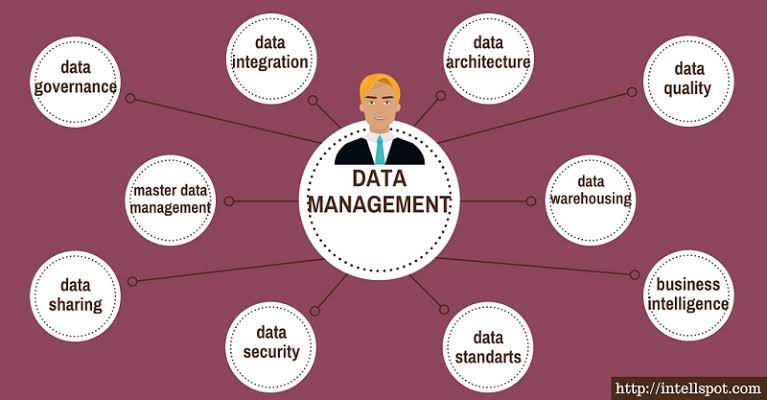
Data management is a broad field that includes several important areas. Each component plays a different role in keeping information useful and reliable.
1. Data Collection
The process begins with collecting information from relevant sources. These sources may include websites, mobile applications, customer surveys, sales systems, sensors, social media platforms, and business software.
Organizations should collect data carefully and only gather information that serves a legitimate business purpose. Poor collection methods can introduce errors that become difficult to fix later.
2. Data Storage
After data is collected, it needs to be stored securely. Businesses may use databases, cloud storage, data warehouses, or other storage technologies depending on their requirements.
The storage environment should be scalable and reliable. It should also provide appropriate access controls so that sensitive information is not available to everyone.
3. Data Quality
Data quality is essential because decisions are only as reliable as the information behind them. High-quality data should generally be accurate, complete, consistent, timely, and relevant.
For example, if a customer database contains outdated phone numbers or duplicate customer profiles, employees may struggle to communicate with customers effectively. Regular data cleansing and validation can help address these issues.
4. Data Security
Protecting information is a critical part of data management. Security measures may include encryption, authentication, authorization, backups, monitoring, and access controls.
Organizations should also create clear policies explaining who can access specific types of data and under what circumstances. Security should be treated as an ongoing process rather than a one-time task.
5. Data Governance
Data governance establishes rules and responsibilities for managing organizational information. It defines how data should be collected, stored, accessed, shared, and maintained.
A strong governance framework can help organizations maintain consistency across departments. It can also clarify who is responsible for specific datasets and how data-related decisions should be made.
6. Data Integration
Businesses often use many different applications and systems. Sales data might exist in one platform, customer information in another, and financial records somewhere else.
Data integration brings information from different sources together so that it can be analyzed and used more effectively. This can provide a more complete view of business operations and customer activity.
Benefits of Effective Data Management
A well-designed data management strategy can provide benefits across almost every area of an organization.
Better decision-making is one of the most obvious advantages. Reliable information gives leaders a stronger foundation for planning and strategy.
Improved efficiency is another important benefit. Employees can locate and use information more quickly when data is organized and accessible.
Lower costs can also result from reducing duplicate records, unnecessary storage, manual processes, and data-related errors.
Stronger customer relationships are possible when businesses have accurate customer information. Companies can better understand customer needs, personalize interactions, and respond to problems more effectively.
There are also significant risk-management benefits. Proper security, governance, and backup practices can reduce the potential impact of data loss, unauthorized access, and operational failures.
Common Data Management Challenges
Although managing data effectively offers many advantages, organizations often face several challenges.
One common problem is data duplication. The same customer or product may appear multiple times in different systems, making it difficult to determine which record is correct.
Another challenge is inconsistent data. Different departments may use different formats or definitions for the same information. For example, one system might record dates as month/day/year while another uses day/month/year.
Data security is also becoming increasingly challenging. As organizations move more operations online and adopt cloud technologies, they must continuously monitor how information is accessed and protected.
There is also the challenge of data growth. Businesses generate more information than ever before, and storing everything indefinitely may not be practical or necessary. Organizations need clear retention policies to determine what should be kept, archived, or securely deleted.
Finally, businesses may struggle with a lack of skilled employees. Effective data management requires people who understand databases, security, governance, analytics, and business requirements.
How to Build an Effective Data Management Strategy
Creating an effective strategy does not necessarily require complicated technology from the beginning. Organizations can start by understanding what data they have and how it is currently being used.
First, identify important data sources and document where information is stored. This helps reveal duplicate systems, disconnected databases, and potential security gaps.
Next, establish clear data ownership. Every important dataset should have responsible individuals or teams who understand its purpose and quality requirements.
Organizations should also create standards for data entry, naming conventions, storage, access, and retention. Consistent standards make information easier to manage across departments.
Regular data-quality checks are equally important. Businesses should monitor for duplicate, incomplete, outdated, or incorrect records and establish processes for correcting them.
Security should be built into every stage of the data lifecycle. Access should be limited according to job responsibilities, while sensitive information should receive additional protection.
Finally, organizations should review their strategy regularly. Business needs, technologies, regulations, and security threats change over time, so data management practices should evolve as well.
The Future of Data Management
The future of data management is closely connected with technologies such as artificial intelligence, automation, cloud computing, and advanced analytics.
Automation can help organizations identify duplicate records, detect unusual activity, classify information, and perform routine data-quality tasks. Artificial intelligence can also help businesses discover patterns within large datasets and support faster analysis.
Cloud-based systems are making it easier for organizations to store and access information without maintaining all infrastructure themselves. At the same time, businesses must carefully consider security, privacy, and governance when moving data to cloud environments.
As data continues to grow, organizations that treat information as a strategic asset will have an advantage. The focus will increasingly shift from simply collecting data to ensuring that data is trustworthy, secure, accessible, and capable of producing meaningful insights.
Frequently Asked Questions (FAQs)
1. What is Data Management in simple words?
Data Management is the process of collecting, storing, organizing, protecting, maintaining, and using information effectively. Its purpose is to ensure that data remains accurate, secure, accessible, and useful.
2. Why is Data Management important for businesses?
It helps businesses make informed decisions, improve efficiency, reduce errors, protect sensitive information, and understand customers better. Reliable data can also help organizations identify opportunities and reduce operational risks.
3. What are the main parts of Data Management?
Major areas include data collection, storage, quality management, security, governance, integration, backup, and data lifecycle management. Together, these practices help organizations maintain reliable and useful information.
4. What is data quality?
Data quality refers to how accurate, complete, consistent, relevant, and up-to-date information is. High-quality data helps organizations produce reliable reports and make better decisions.
5. How does Data Management improve data security?
It supports security through practices such as access controls, authentication, encryption, monitoring, backups, and clear security policies. These measures help reduce the chances of unauthorized access or data loss.
6. What is data governance?
Data governance is a framework of rules, responsibilities, standards, and processes used to manage organizational data. It helps determine who can access information, how it should be handled, and who is responsible for maintaining it.
7. What are the biggest Data Management challenges?
Common challenges include duplicate records, inaccurate information, disconnected systems, growing data volumes, security threats, inconsistent standards, and a shortage of skilled data professionals.
8. How can a business improve its Data Management?
A business can start by identifying its data sources, assigning data ownership, establishing quality standards, improving security controls, removing duplicate information, and regularly reviewing its data processes. A gradual and well-planned approach can make improvements easier to manage.
Conclusion
Data is only valuable when an organization can trust and use it effectively. Data Management provides the processes, policies, technologies, and practices needed to turn large amounts of information into a useful business resource.
From collection and storage to security, governance, integration, and quality control, every stage of the data lifecycle matters. Businesses that invest in effective data practices can improve decision-making, increase efficiency, protect sensitive information, and create better experiences for their customers.
As organizations continue to generate and depend on more information, strong data management will become even more important. Instead of viewing data as something that simply needs to be stored, businesses should treat it as an asset that requires careful planning, protection, and continuous improvement.