
Artificial intelligence has become an important part of modern technology, and one of the key technologies behind many AI systems is Neural Networks. From recognizing faces in photos to understanding spoken language and recommending products online, neural networks help computers perform tasks that once required human intelligence.
Although the term may sound complicated, the basic idea is relatively simple. A neural network is a computer system designed to learn patterns from information. Instead of being programmed with a specific rule for every possible situation, it can analyze examples, identify relationships, and improve its performance over time.
Today, neural networks are used in healthcare, finance, transportation, entertainment, cybersecurity, customer service, and many other industries. Understanding how they work can provide a useful introduction to the broader world of artificial intelligence.
What Are Neural Networks?
Neural networks are machine learning models inspired loosely by the way biological neurons process information. A typical neural network contains connected units called artificial neurons, which work together to process data and produce an output.
For example, imagine teaching a computer to recognize pictures of cats. You could provide the network with thousands of images, some containing cats and others containing different objects. During training, the network looks for patterns that help distinguish one image from another.
It may gradually learn features such as shapes, edges, textures, and combinations of visual characteristics. After enough training, the network can use what it has learned to make predictions about new images.
The important point is that the system learns from data rather than relying entirely on manually written instructions.
How Do Neural Networks Work?
A neural network generally consists of three main types of layers: an input layer, one or more hidden layers, and an output layer.
The input layer receives the information. Depending on the application, this information could be an image, text, sound, numbers, or other forms of data.
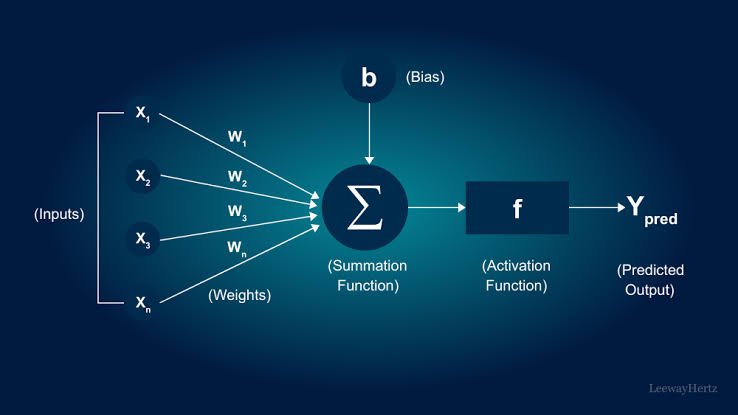
The hidden layers process that information. Each artificial neuron receives values from other neurons, applies weights to those values, and passes the result through an activation function. As information moves through the network, increasingly complex patterns can be identified.
Finally, the output layer produces the result. For instance, it might determine whether an image contains a cat, predict a house price, or identify the sentiment of a written review.
During training, the network compares its predictions with the correct answers. It then adjusts its internal weights to reduce errors. This process is repeated many times, allowing the model to gradually improve.
What Is Deep Learning?
Deep learning is a major area of machine learning that uses neural networks with multiple hidden layers. These deeper networks can learn highly complex patterns from large amounts of data.
The term “deep” refers mainly to the number of processing layers in the network. A simple neural network may have only a few layers, while a deep learning model can contain many layers.
Deep learning has played a major role in recent advances in artificial intelligence. It has helped improve computer vision, speech recognition, natural language processing, recommendation systems, and generative AI.
However, deeper models can also require substantial computing power, large datasets, and careful training.
Common Types of Neural Networks
Different neural network architectures are designed for different kinds of problems.
Feedforward Neural Networks
Feedforward neural networks are among the simplest types. Information moves in one direction, from the input layer through hidden layers to the output layer.
They can be useful for classification, prediction, and other structured data tasks. While relatively straightforward, they may not be the best choice for problems involving sequences or complex spatial relationships.
Convolutional Neural Networks
Convolutional Neural Networks, often called CNNs, are particularly effective for image and visual data. They can identify important features within images by examining small sections and learning spatial patterns.
CNNs have been widely used for facial recognition, medical image analysis, object detection, and autonomous vehicle vision systems.
Recurrent Neural Networks
Recurrent Neural Networks, or RNNs, were designed to work with sequential information. They can use information from earlier parts of a sequence when processing later information.
This makes them suitable for certain applications involving text, speech, and time-series data. Modern systems often use more advanced architectures for many of these tasks, but RNNs remain important in the history and development of sequence-based machine learning.
Transformer Networks
Transformers have become one of the most influential neural network architectures in modern AI. They are particularly powerful for processing language and other sequences.
Transformers can analyze relationships between different parts of an input and process information efficiently. Many modern language models and AI assistants are built using transformer-based architectures.
How Are Neural Networks Trained?
Training is one of the most important parts of building a neural network.
First, developers collect and prepare a dataset. The quality and relevance of this data can strongly affect the final model. The data may need to be cleaned, labeled, normalized, or divided into different groups for training and evaluation.
During training, the network makes predictions based on the current values of its internal parameters. The prediction is compared with the expected result using a mathematical measurement called a loss function.
An optimization method then adjusts the network’s parameters to reduce the loss. One commonly used approach is based on gradient descent and backpropagation.
This cycle can happen thousands or millions of times. Over repeated training steps, the network can become better at recognizing patterns in the data.
After training, the model should be tested on information it has not seen before. This helps determine whether it has genuinely learned useful patterns or simply memorized its training examples.
Benefits of Neural Networks
Neural networks offer several advantages that make them valuable across different industries.
One major benefit is their ability to learn complicated relationships in large datasets. Traditional programming often requires humans to define detailed rules, while neural networks can discover many useful patterns automatically.
They can also work with different forms of unstructured information, including images, audio, and natural language. This flexibility has made them especially useful in modern AI applications.
Another advantage is that neural networks can improve as training data, model architectures, and computing resources improve. Large-scale models can achieve impressive performance on tasks that were previously difficult for computers.
Limitations of Neural Networks
Despite their strengths, neural networks are not perfect.
One important limitation is their dependence on data. A model trained on poor-quality, incomplete, or biased data can produce unreliable results. In some situations, collecting enough high-quality training data can be expensive and time-consuming.
Neural networks can also require significant computing resources, particularly large deep learning models. Training sophisticated systems may involve powerful processors and substantial energy consumption.
Another challenge is interpretability. Some neural networks can contain millions or billions of parameters, making it difficult to understand exactly why a particular prediction was produced. This can be especially important in sensitive areas such as healthcare, finance, and law.
Real-World Applications of Neural Networks
Neural networks are already being used in many everyday technologies.
In healthcare, they can help analyze medical images, identify patterns in patient data, and support medical research. They are generally used as tools to assist professionals rather than replace expert judgment.
In finance, neural networks can be used for fraud detection, risk analysis, forecasting, and customer service.
In transportation, AI systems can process information from cameras and sensors to help vehicles understand their surroundings.
In retail and entertainment, recommendation systems can analyze user behavior and suggest products, movies, music, or other content that may be relevant.
Neural networks are also important in natural language processing. They can help systems translate languages, summarize documents, answer questions, analyze sentiment, and generate text.
The Future of Neural Networks
The development of neural networks is likely to continue as researchers discover new architectures, training methods, and applications.
Future systems may become more efficient, requiring less computing power while maintaining strong performance. Researchers are also working on making AI models more reliable, transparent, secure, and resistant to unwanted bias.
Another important direction is the combination of different types of information. Modern AI systems can increasingly work with text, images, audio, video, and other data within the same general framework.
As these technologies develop, neural networks will likely remain an important foundation of artificial intelligence.
Frequently Asked Questions
1. What is a neural network in simple words?
A neural network is a type of computer model that learns patterns from data. It uses connected artificial neurons to process information and make predictions or decisions.
2. Are neural networks the same as artificial intelligence?
No. Neural networks are one technology used within artificial intelligence. AI is a much broader field that includes many different methods, including machine learning and neural networks.
3. What are neural networks used for?
They are used for tasks such as image recognition, speech processing, language translation, recommendations, fraud detection, forecasting, and many other machine learning applications.
4. What is the difference between machine learning and neural networks?
Machine learning is a broad area of AI focused on systems that learn from data. Neural networks are one type of machine learning model. Deep learning is a specialized approach that typically uses neural networks with multiple layers.
5. Why are neural networks important?
Neural networks are important because they can learn complex patterns from large datasets and handle tasks involving images, text, speech, and other forms of information. They are a major foundation of many modern AI technologies.
Conclusion
Neural networks have changed the way computers learn from information. Instead of depending entirely on manually written rules, these models can identify patterns in data and use those patterns to make predictions.
From image recognition and medical research to language processing and recommendation systems, neural networks have become an essential part of modern artificial intelligence. They also come with challenges, including data requirements, computing costs, bias, and limited interpretability.
As research continues, neural networks are expected to become more capable and efficient. For anyone interested in artificial intelligence, understanding the basic principles of neural networks is an excellent starting point for exploring how modern AI systems work.