
Machine Learning has become one of the most important technologies of the modern digital world. From the recommendations we see on streaming platforms to the fraud alerts sent by banks, machine learning is quietly working behind many of the services we use every day. Although the technology may sound highly technical, its basic idea is quite simple: computers can learn from data and improve their performance without being explicitly programmed for every individual task.
As businesses, governments, and individuals generate enormous amounts of data, the importance of Machine Learning continues to grow. It helps organizations discover patterns, make predictions, automate repetitive processes, and make better decisions. Today, it is used in healthcare, finance, education, transportation, marketing, cybersecurity, retail, and many other industries.
What Is Machine Learning?
Machine Learning is a branch of artificial intelligence that allows computer systems to learn from data and experience. Instead of giving a computer a detailed set of instructions for every possible situation, developers provide algorithms with data from which the system can identify patterns and relationships.
For example, imagine a system designed to recognize whether an email is spam. Rather than programming every possible spam message manually, developers can train a machine learning model using thousands of examples of spam and legitimate emails. Over time, the model learns characteristics that commonly appear in spam messages and uses those patterns to classify new emails.
The quality of a machine learning system largely depends on the quality and quantity of the data used to train it. Good data can help a model make accurate predictions, while incomplete, biased, or incorrect data can produce unreliable results.
How Does Machine Learning Work?
Although different machine learning systems work in different ways, most follow a general process.
First, data is collected from sources such as databases, websites, sensors, applications, customer interactions, or digital devices. The collected information is then cleaned and organized because raw data often contains errors, duplicates, or missing values.
Next, relevant information is selected and prepared for training. A machine learning algorithm analyzes this data and searches for meaningful patterns. During training, the model adjusts itself to improve its predictions or classifications.
After training, the model is tested using data it has not previously seen. This step helps determine whether the model has genuinely learned useful patterns or simply memorized its training data.
Once the model performs well, it can be deployed in a real-world environment. It can then analyze new information and produce predictions, recommendations, classifications, or other results.
Machine learning models are not necessarily perfect after deployment. As new data becomes available, organizations may retrain or update their models to maintain performance.
Main Types of Machine Learning
Machine Learning is commonly divided into several major categories.
Supervised Learning
Supervised learning uses labeled data. This means the training examples already contain the correct answers.
For instance, a bank might use historical transactions labeled as either fraudulent or legitimate. A supervised learning algorithm can study these examples and learn to identify suspicious transactions in the future.
Supervised learning is commonly used for tasks such as image classification, price prediction, customer churn prediction, and spam detection.
Unsupervised Learning
Unsupervised learning works with data that does not have predefined labels. The system attempts to discover hidden structures or patterns on its own.
A common example is customer segmentation. A company may have information about thousands of customers but no predefined groups. An unsupervised learning algorithm can analyze purchasing behavior and identify groups of customers with similar characteristics.
This approach can help businesses understand their audiences and discover patterns that may not be immediately obvious.
Reinforcement Learning
Reinforcement learning is based on learning through interaction. An agent performs actions in an environment and receives rewards or penalties depending on the results.
Over many attempts, the system learns which actions are more likely to produce desirable outcomes. Reinforcement learning has been used in robotics, gaming, optimization, and other complex decision-making environments.
Applications of Machine Learning
The practical applications of Machine Learning are expanding rapidly.
In healthcare, machine learning can assist doctors by analyzing medical images, identifying potential risks, and helping researchers study diseases. It can also support personalized treatment by examining information about individual patients.
In finance, machine learning is widely used for fraud detection, credit assessment, risk analysis, and financial forecasting. Banks can analyze large numbers of transactions and identify unusual behavior much faster than would be possible through manual review alone.
The retail industry also benefits from machine learning. Online stores can analyze customer behavior to recommend products that may be relevant to individual shoppers. Businesses can use similar technology to predict demand, manage inventory, and improve marketing campaigns.
Transportation is another important area. Machine learning can help predict traffic patterns, optimize routes, improve logistics, and support the development of autonomous vehicles.
In cybersecurity, machine learning can identify unusual network activity and potentially detect threats. Because cyberattacks constantly change, systems that can recognize suspicious patterns can provide an additional layer of protection.
Even education is becoming more data-driven. Learning platforms can analyze student performance and recommend materials based on individual needs. This can help create more personalized learning experiences.
Benefits of Machine Learning
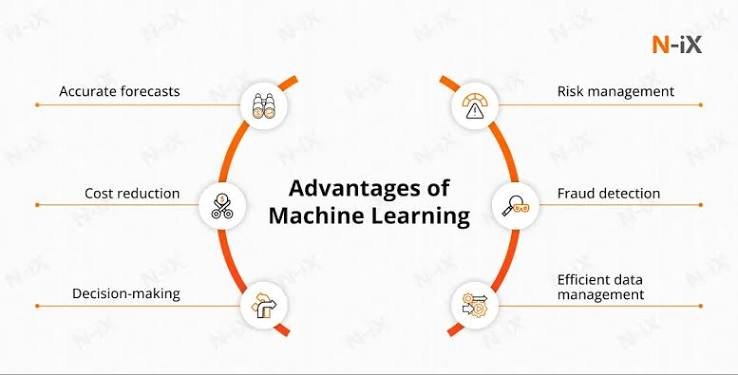
One of the biggest advantages of Machine Learning is its ability to process large amounts of information quickly. Humans can analyze data, but machines can examine millions of records in a relatively short period.
Automation is another major benefit. Machine learning can handle repetitive analytical tasks, allowing employees to spend more time on creative, strategic, or interpersonal work.
Machine learning can also improve decision-making. When properly designed and trained, models can identify patterns that humans might overlook. Businesses can use these insights to understand customers, predict demand, reduce risks, and improve operations.
Personalization is another important advantage. Many digital services use machine learning to provide content, products, advertisements, or recommendations based on individual behavior.
Challenges and Limitations
Despite its benefits, Machine Learning also has significant challenges.
Data quality is one of the biggest concerns. If training data is incomplete or biased, the resulting model may produce biased or inaccurate predictions. This is particularly important when machine learning is used in sensitive areas such as employment, lending, healthcare, or law enforcement.
Privacy is another major issue. Many machine learning systems require large amounts of personal or behavioral data. Organizations must handle this information responsibly and comply with applicable privacy requirements.
Some models are also difficult to understand. Complex systems may produce accurate predictions without providing a simple explanation of how they reached a particular result. This lack of transparency can be problematic when people need to understand or challenge automated decisions.
Security presents additional challenges. Machine learning systems can sometimes be manipulated through specially designed inputs or attacks. For this reason, organizations need strong security practices throughout the development and deployment process.
Finally, machine learning requires skilled professionals, computing resources, and ongoing maintenance. Building an effective system is not simply a matter of selecting an algorithm and pressing a button.
Machine Learning and Artificial Intelligence
Machine Learning and Artificial Intelligence are closely connected, but they are not exactly the same thing.
Artificial Intelligence is the broader concept of creating systems that can perform tasks associated with human intelligence, such as reasoning, perception, planning, and language understanding.
Machine Learning is one of the major approaches used to build AI systems. In simple terms, Machine Learning focuses on enabling systems to learn from data, while Artificial Intelligence represents the broader goal of creating intelligent behavior in machines.
Deep Learning is another related concept. It is a specialized area of machine learning that uses multi-layered neural networks and has achieved impressive results in areas such as image recognition, speech processing, and natural language applications.
The Future of Machine Learning
The future of Machine Learning is likely to involve deeper integration into everyday technology. As computing power increases and more data becomes available, machine learning models may become more capable and efficient.
Businesses are expected to use machine learning more extensively for automation, forecasting, customer service, and decision support. Healthcare researchers may continue exploring its potential in medical research and personalized care. Smart transportation, robotics, language technology, and cybersecurity are also likely to remain important areas of development.
At the same time, responsible development will become increasingly important. Organizations will need to think carefully about privacy, fairness, transparency, security, and accountability. Technological progress is valuable, but it needs to be balanced with responsible use.
Frequently Asked Questions About Machine Learning
1. What is Machine Learning in simple words?
Machine Learning is a technology that allows computers to learn from data and improve their performance without requiring programmers to provide instructions for every situation. It helps computers recognize patterns, make predictions, and perform tasks based on previous information.
2. How does Machine Learning work?
Machine Learning works by collecting and analyzing data. An algorithm uses training data to identify patterns and relationships. After learning from the available examples, the model can use what it has learned to make predictions or decisions when it receives new data.
3. What are the main types of Machine Learning?
The three commonly discussed types are supervised learning, unsupervised learning, and reinforcement learning. Supervised learning uses labeled data, unsupervised learning finds patterns in unlabeled data, and reinforcement learning learns through actions, rewards, and penalties.
4. What is the difference between AI and Machine Learning?
Artificial Intelligence is a broad field focused on creating systems that can perform tasks associated with human intelligence. Machine Learning is a major part of AI that enables computers to learn patterns from data and improve their performance without being explicitly programmed for every task.
5. Where is Machine Learning used?
Machine Learning is used in many industries, including healthcare, banking, retail, transportation, education, cybersecurity, marketing, and entertainment. Common examples include recommendation systems, fraud detection, spam filtering, medical image analysis, and personalized online services.
6. What are the benefits of Machine Learning?
Machine Learning can process large amounts of data, automate repetitive tasks, identify hidden patterns, improve predictions, and support better decision-making. It can also help businesses personalize services and improve operational efficiency.
Conclusion
Machine Learning has changed the way computers interact with data and solve problems. Instead of relying entirely on fixed instructions, modern systems can learn patterns from examples and use those patterns to make predictions or decisions.
Its applications range from healthcare and finance to retail, transportation, education, and cybersecurity. The technology offers significant benefits, including automation, faster data analysis, personalization, and improved decision-making.
However, Machine Learning also brings challenges related to data quality, privacy, bias, transparency, and security. Understanding these limitations is just as important as recognizing its potential.
As the technology continues to develop, Machine Learning will likely become an even more important part of digital life. The organizations that use it responsibly and combine technological capabilities with human judgment will be better positioned to benefit from what this powerful technology has to offer.